
lon Musk’s Mars Ambition: A Thorough Scientific and Technical Reality Check
When Elon Musk declared that humanity should become a multiplanetary species, the statement read like a manifesto more than a program. Two decades later, SpaceX has become the single most consequential private driver of that vision: reusable boosters, rapid iteration on prototypes, and the audacity to imagine shipping hundreds of people off planet. That mix of ambition and execution is rare. But enthusiasm cannot replace physics, biology, or systems engineering. If Musk’s dream is to move from poster to program, it must survive meticulous scrutiny: propulsion economics, life-support mass budgets, radiation mitigation, autonomous construction, and the full industrial chain of in-situ resource utilization (ISRU).
This article drills into those technical corners. It asks: which problems are tractable with current trajectories of engineering? Which require breakthroughs? And how does a recalibrated timeline — admitting decades rather than years — change the shape of the effort?
The Rocket Equation and the Starship Doctrine
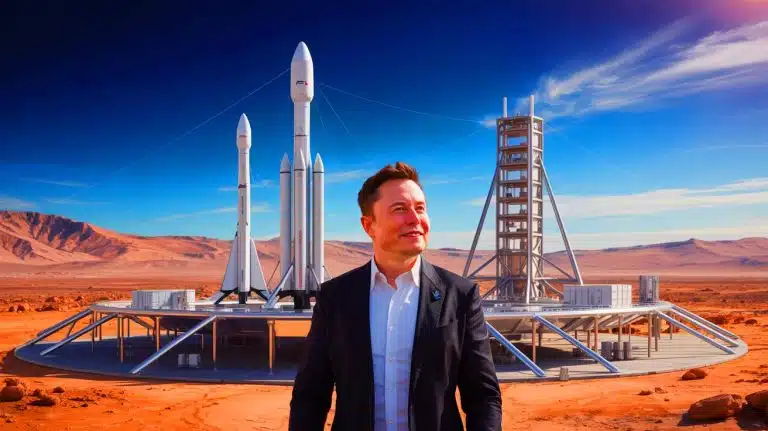
SpaceX’s central enabler is Starship: a fully reusable two-stage stack (Super Heavy booster + Starship upper stage) designed to carry large payloads and dozens of people. The promise is dramatic: radically lower cost per kilogram to orbit. Yet the economics and physics remain governed by the rocket equation, which dictates how much propellant must be carried to generate a given change in velocity (delta-v). Launch mass scales exponentially with the fuel fraction. Transporting heavy infrastructure—habitats, ISRU plants, power systems—to Mars and back (or to orbit for earth return) therefore imposes steep mass penalties.
Two key strategies reduce that penalty: reusability and in-situ propellant production. Reusability buys down cost per launch, while ISRU (manufacturing fuel on Mars) reduces the need to haul return propellant from Earth. The canonical ISRU pathway for methane-oxygen propulsion uses the Sabatier reaction—CO₂ + 4H₂ → CH₄ + 2H₂O—paired with electrolysis to restore hydrogen and produce oxygen. The feasibility depends on reliable water/ice extraction, robust electrolysis hardware, and long-duration operation in a dusty, cold environment. That’s engineering at industrial scale in conditions that have no forgiving margin.
Operational constraints further complicate matters. Earth–Mars transfer opportunities come roughly every 26 months (conjunction windows), so logistics must be planned in campaigns, with prepositioning of fuel and habitats sometimes years before crewed departures. Starship must demonstrate not only launch reliability but also rapid cadence: hundreds of flights across several years, with consistent payload performance and low turnaround costs.
In short: Starship addresses the transportation piece, but Mars colonization requires scaling whole industries off-planet—ISRU, power, manufacturing — and those remain the true bottlenecks.
Life Support: Closing the Loop at City Scale
Life-support on Mars is not an engineering novelty; it is an entire ecology. For a handful of astronauts, closed-loop systems (water reclamation, CO₂ scrubbers, oxygen generation) are manageable. NASA’s MOXIE experiment, which produced oxygen from Martian CO₂, proved the chemistry works on a small scale. But scaling from a “toaster-sized” demonstrator to a system supporting dozens or hundreds is a different category of challenge.
Key subsystems needed:
Air revitalization: Electrochemical CO₂ conversion, robust CO₂ scrubbers, oxygen storage and cycling, and leak-tolerant pressurization systems.
Water management: Extraction from subsurface ice, atmosphere adsorption units (for low-pressure capture), and near-100% water recycling. Every lost liter from leaks is a strategic vulnerability.
Food production: Hydroponics, aeroponics, or vertical farming integrated into habitat volumes. Growing staple calories requires efficient LEDs, nutrient cycles, pollination strategies (possibly robotic), and microbial control. Crop diversity is critical to provide complete nutrition and psychological variety.
Waste recycling: Turning human and organic waste into nutrients for plants—microbial bioreactors are promising but require rigorous containment and pathogen control.
Mass and redundancy rules: each subsystem adds mass, complexity, and spare-part needs. Conventional terrestrial thinking (buy a backup or fly a resupply) becomes untenable at scale. Thus a Martian colony needs robust modularity—systems that can operate in degraded modes, be swapped out, and be repaired with local resources or 3D-printed parts using regolith feedstocks.
Radiation: The Silent Biological Threat
Mars lacks both the magnetosphere and atmospheric depth that shield Earth’s surface. Galactic cosmic rays (GCRs) and solar energetic particle (SEP) events deliver chronic and acute doses that damage DNA and increase cancer risk, cognitive decline, and degenerative disease.
Rough ballpark numbers from radiation modeling indicate unshielded surface doses on Mars could be tens to hundreds of millisieverts per year—orders of magnitude higher than natural background on Earth. Across a lifetime, cumulative exposure matters. Strategies for mitigation include:
Subsurface habitats: Buried habitats beneath meters of regolith dramatically reduce exposure—regolith acts as a cheap shield.
Water/ice barriers: Water is a hydrogen-rich, excellent attenuator for particle radiation. Tanks or layers of ice can double as shielding and resource stores.
Low-mass hydrogenated plastics: Polymer composites with high hydrogen content provide shielding with less mass than metals for certain spectra of radiation.
Storm shelters: Hardened hatches or modules where surface crews can shelter during SEP events.
Beyond shielding is biological adaptation: research into pharmaceuticals that mitigate radiation damage, genomic screening for susceptibility, and real-time dosimetry and repair-assisted therapies. These are nascent areas; none are turnkey.
Another radiation issue is the transit phase. The interplanetary cruise (six to nine months) exposes crews to unattenuated space radiation, reinforcing the argument for shorter transit durations and possibly cryogenic or radiation-mitigated transit architectures. Artificial gravity (via rotating habitats) during transit has been proposed to mitigate microgravity deconditioning, but it adds mechanical complexity and mass.
Energy Infrastructure: Solar, Nuclear, and the Grid on Mars
Power is the lifeblood of a colony: mining, ISRU chemical plants, life-support, communications, and manufacturing all require continuous energy. Mars receives roughly 43% of Earth’s solar irradiance; dust storms can last weeks and degrade panel performance. Solar plus batteries is viable for small outposts, but for industrial ISRU plants and year-round reliability, nuclear fission—compact reactors—becomes compelling.
NASA’s Kilopower program demonstrated small fission reactor concepts capable of kilowatts to hundreds of kilowatts of reliable baseload power. A pragmatic architecture could pair Kilopower reactors for baseload with large solar arrays for peak demand and redundancy. Nuclear introduces complexity: safe transport and deployment of a reactor, regulatory and political hurdles, radiological safety, and heat rejection in a thin atmosphere.
Distribution: a Martian microgrid needs robust smart control, energy storage (lithium, flow batteries, or even cryogenic storage depending on plant architecture), and the ability to island micro-sectors in case of failures. Again, robotics and autonomous maintenance are prerequisites—humans cannot be repairing high-value power systems while also struggling to produce food.
Construction from Dirt: Regolith as Feedstock
Shipping concrete, steel, and glass at scale is prohibitively expensive. Instead, the colony must build with local materials. Approaches include:
Sintering regolith: Concentrated solar or microwave sintering can produce solid blocks from native soil.
Sulfur concrete: Melting sulfur (available in many planetary regoliths) creates binders that set without water.
3D printing: Robotic extrusion printers deposit layers to form habitats, landing pads, or berms that provide shielding.
Glass production: Vitrifying regolith on site can yield structural glass for windows or optical arrays.
All of the above demand robust robotics, precision control, and dust mitigation strategies. Martian regolith contains perchlorates—oxidizing salts that are toxic to humans and plants—so handling and processing require chemical treatments or containment protocols to avoid contaminating habitats or food cycles.
Autonomy and AI: The Colony’s Silent Workforce
Because communication delays to Earth range from about 4 to 22 minutes one-way, Martian operations must be highly autonomous. AI will orchestrate the work: scheduling robotic construction, diagnosing system failures, optimizing power flows, and managing life-support chemistry. Machine learning can predict failure modes from sensor drift before critical abuse; reinforcement learning can guide robotic excavators through unfamiliar regolith.
Key AI roles:
Autonomous heavy construction and maintenance.
Predictive maintenance for closed-loop life systems.
Agricultural optimization: dynamically adjusting light spectra, nutrient mixes, and root aeration.
Navigation and coordination of fleets of rovers and drones.
Important caveat: autonomy implies the need for transparency and verifiable safety. Black-box systems that fail in odd ways are unacceptable when lives depend on them. Explainable AI and hardware redundancy will be requirements, not conveniences.
Biology, Medicine, and Habitability Research Needs
Microbiomes, pathogen control, and long-term health monitoring are critical. Confined habitats produce unique microbial ecologies; preventing opportunistic infections—especially in partially immune-compromised crews due to radiation or stress—is essential.
Medical capacity in a Martian outpost will be limited. Telemedicine with Earth is delayed; diagnostics and surgical interventions must be possible with local resources. Biomanufacturing—using engineered microbes to produce pharmaceuticals and vaccines on demand—is a promising path. Tissue printing for wound repair and compact diagnostic labs that can sequence DNA in-situ (like nanopore sequencers) may become indispensable.
The Global Context: NASA, China, and Commercial Players
SpaceX is not operating alone in a vacuum of competitors. NASA’s approach is incremental: return to the Moon (Artemis) and use cislunar infrastructure as staging points for Mars. China has declared Mars ambitions and invests heavily in robotic exploration. Other private actors—Blue Origin, international aerospace firms—pursue complementary or competing strategies.
This multipolar environment complicates but also accelerates progress. International collaboration can pool expertise and reduce duplicated costs; competition can spur investment and pace. But geopolitics will shape launch rights, resource claims, and long-term governance frameworks—a detail often overlooked in technical discussions.
Timeline Reality Check: From Hype to Pragmatism
Musk’s earlier timelines—human boots on Mars in the 2020s—were aspirational provocations. A sober read suggests a phased progression:
Near term (2020s–early 2030s): Continued Starship flight tests; robotic prepositioning missions; scaled MOXIE-class demonstrations; fledgling autonomous construction trials.
Medium term (2030s–2040s): Possible first crewed missions if ISRU pilots succeed and Starship reaches high flight cadence. Early outposts focused on science and demonstration rather than large-scale habitation.
Long term (2040s–2060s+): If ISRU, energy baseload, habitat construction, and closed-loop life support reach reliability, outposts could expand toward dozens or hundreds of residents. This window depends on a cascade of successful engineering deployments and sustained funding.
The practical conclusion: a sustainable, self-sufficient Martian colony by 2050 is ambitious; plausible only if multiple high-risk developments converge successfully. More likely, the march to habitability will be measured in many incremental, interdependent advances spanning decades.
Risk, Ethics, and Mission Priorities
Colonizing Mars raises ethical questions: who decides who goes? What planetary protection policies prevent contamination of potentially extant Martian biosignatures? How will resource extraction be governed? There are also existential risks: putting a significant portion of humanity’s resources into off-planet projects risks diverting attention and capital from pressing Earth-bound challenges.
Yet the technological spin-offs—improved energy storage, robust recycling, autonomous manufacturing—can create terrestrial benefits. The framing that pits Earth vs Mars is a false dichotomy; well-managed programs can advance both.
Conclusion — A Marathon of Engineering, Not a Sprint of Hype
Elon Musk has shifted his language from bold timelines to a more tempered view: crewed missions may be possible in the 2030s, but a true, sustainable colony is a decades-long project. That realism does not make the goal less meaningful. On the contrary, it anchors the work in a sequence of concrete technical milestones: reliable heavy lift and rapid cadence; validated ISRU fuel production; robust radiation-hardened habitats; dependable energy grids; and fleets of autonomous robots that can build and maintain infrastructure.
The physics is unforgiving, the biology complex, and the logistics planetary in scale. Yet incremental wins—repeatable rocket reusability, modular ISRU pilots, compact nuclear baseload units, and autonomous construction demonstrations—compound. Each is a prerequisite for the next. If those building blocks coalesce, the path to Mars becomes not a single bold step but a disciplined program of engineering and systems integration.
Musk’s recalibration—acknowledging that Mars is a marathon, not a sprint—is the right tone for the era ahead. The romance of destiny remains, but it must be matched by the rigor of systems engineering, sober timelines, and patient funding. In that synthesis lies the real promise: not a celebrity’s deadline, but the slow, steady birth of a new chapter for human exploration.
News

Un padre regresa del ejército y descubre que su hijastra ha sido obligada por su madrastra a hacer las tareas del hogar hasta sangrar, y el final deja horrorizada a la madrastra.
Después de dos años lejos de casa, tras días abrasadores y noches frías en el campo de batalla, el Capitán…

Una niña de 12 años hambrienta pidió tocar el piano a cambio de comida, y lo que sucedió después dejó a todos los millonarios en la sala asombrados.
Una niña de doce años hambrienta preguntó: “¿Puedo tocar el piano a cambio de algo de comida?” Lo que sucedió…

Se rieron de ella por almorzar con el conserje pobre, pero luego descubrieron que él era el director ejecutivo de la empresa.
Se rieron de ella por compartir el almuerzo con el conserje pobre, hasta que descubrieron que él era el director…

La multimillonaria soltera se arrodilló para pedirle matrimonio a un hombre sin hogar, pero lo que él exigió dejó a todos conmocionados.
“Por favor, cásate conmigo”, suplicó una madre soltera multimillonaria a un hombre sin hogar. Lo que él pidió a cambio…

Nadie se atrevía a salvar al hijo del millonario, hasta que apareció una madre pobre sosteniendo a su bebé y una acción temeraria hizo llorar a todos.
Nadie se atrevía a salvar al hijo del millonario, hasta que una madre negra y pobre que sostenía a su…

Un maestro escuchó el aterrador susurro de un niño y los descubrimientos de la policía dejaron a todos sorprendidos.
Un Maestro Escuchó a un Niño Susurrar “Esta Noche Me Voy a Escapar Antes de Que Él Me Encuentre” y…
End of content
No more pages to load