
The Bridge of Tears and Redemption
My hometown, Dong village, was nothing more than a tiny speck on the map, a place so poor that travelers rarely bothered to stop. The village lay between endless rice paddies, with roofs of moss-covered tiles leaning tiredly against each other. Life there was simple, but it was also heavy—like the humid air that pressed down on our chests every summer.
The roads were nothing more than dirt paths. When it rained, they turned into sticky rivers of mud. Children went to school barefoot, their little legs splashing through puddles, their notebooks held above their heads like fragile wings trying to avoid the rain. Farmers bent under the scorching sun from dawn until their shadows melted into the ground. In the evenings, old men sat on bamboo cots chewing betel nut, while women fanned themselves with palm leaves, their eyes carrying the exhaustion of poverty.
Yet even within that hardship, Dong village still breathed warmth. We shared what little we had: a handful of salt, a bowl of rice, a smile across the fence. Laughter still echoed from the children’s games, their bare feet tapping rhythms into the dirt alleys. To me, that laughter was the music that kept our poor village alive.
But everything changed the day the government approved a project: a bridge across the wide stream that divided our land. Suddenly, trucks and machines rumbled into Dong village, carrying with them dust, noise, and an energy we had never known before. For the first time, the quiet heartbeat of the village quickened.
The fields no longer sang only with the cries of birds, but also with the pounding of hammers, the roar of engines, and the shouts of men. Some villagers grumbled about the noise, but most were filled with curiosity. They would gather near the stream, eyes wide, marveling as if witnessing magic. For me, the bridge was more than just stone and steel—it was a promise that life could be different.
And among the workers, there was one who drew my eyes again and again. His name was Thang.
He was tall, though a little thin, his skin tanned by years under the sun. His hands were rough, yet his smile was gentle—gentle enough to melt the tiredness from anyone who looked at him. Unlike some workers who kept to themselves, Thang mingled easily with the villagers. He fetched water for old women whose backs were bent with age. He helped carry firewood, sometimes even lent a hand in the rice fields. When he played with the children, their laughter rang like bells, filling the village with joy.
At first, I told myself he was nothing special, just another worker passing through. But slowly, without realizing, I began to notice him more than the others. I would catch myself watching the way the sunlight caught in his hair, or how his laughter carried on the breeze. My heart skipped when our eyes met. I began to look for him every morning, as if my day could not begin until I saw that smile.
One evening, after the workers had finished their day, they held a small celebration under the flickering glow of lanterns. There was cheap wine, boiled peanuts, and the warmth of camaraderie. Thang and I slipped away from the noise, finding ourselves under the great banyan tree at the village entrance. The air was heavy with the scent of earth and night-blooming flowers. The moon poured its silver light upon us, and the wind played gently with my hair.
He looked at me then—not with the casual glance of a friend, but with eyes full of fire and tenderness. My heart trembled. I could hear it pounding so loudly I thought he might hear it too. That night, under the banyan tree, I gave him my heart, my innocence, my very self. I believed, with the faith of a naïve girl, that I had finally found the anchor of my life.
But happiness is fleeting.
When the bridge neared completion, Thang vanished. He did not leave a note, nor a word of farewell. One morning, I went to the site with a basket of food, and his spot was empty. I searched desperately. I ran along the stream, asked his colleagues, begged for answers. But they only shook their heads, eyes avoiding mine.
I returned home, my chest hollow, my body trembling. That night, I cried until my pillow was soaked, calling his name into the darkness. The banyan tree, once a witness to love, now loomed like a cruel reminder of my foolishness.
Not long after, I discovered I was pregnant.
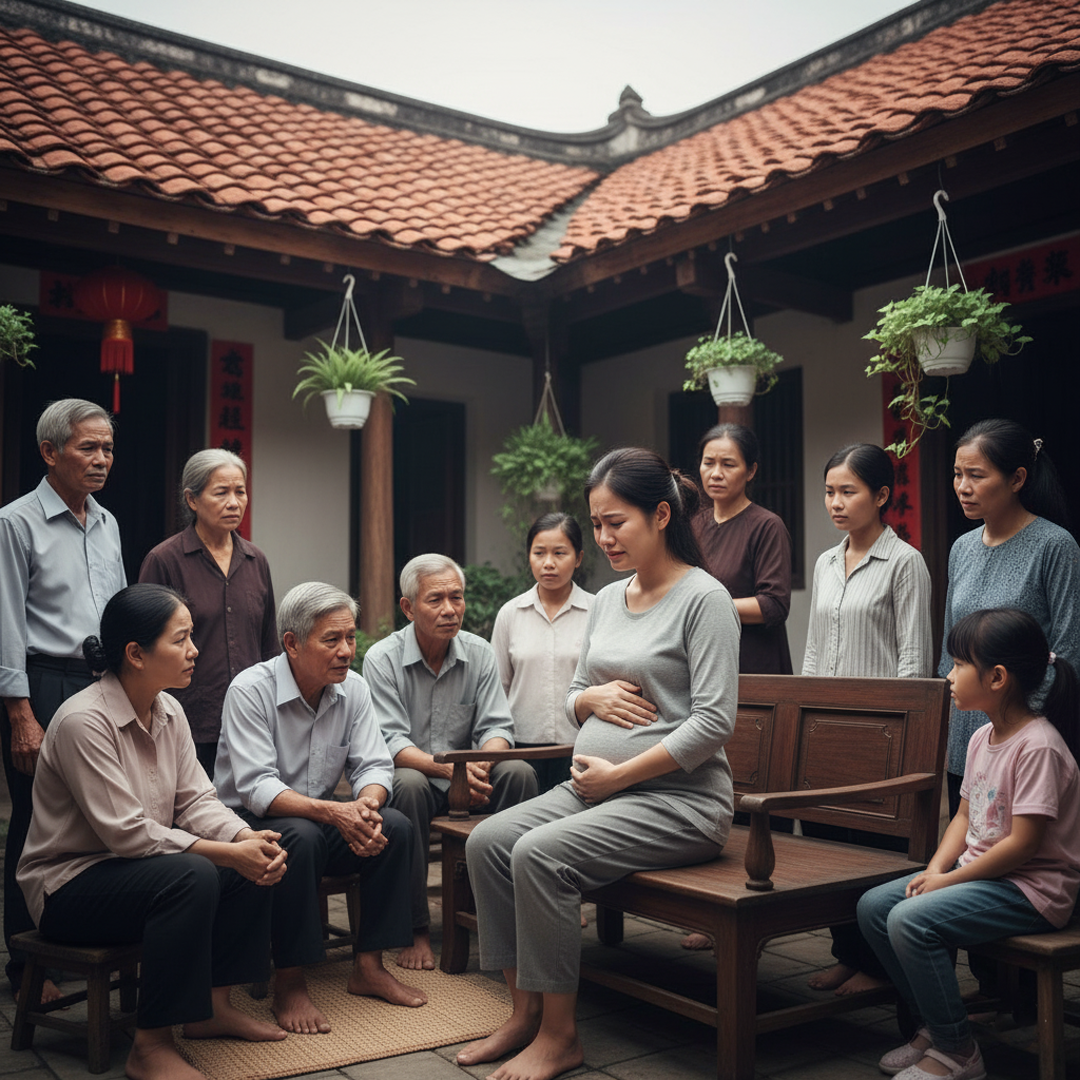
I remember the moment vividly. My hands shook as I held my belly, still flat but already different. Terror gripped me, mingled with a strange, fragile joy. Inside me, a life had begun—a tiny heartbeat, a spark. But alongside that spark was a storm of fear. I was young, unmarried, and alone. What would become of me? What would the villagers say?
At first, I clung to hope. Perhaps Thang had only gone briefly. Perhaps he would return. Each day, I looked down the dusty road, waiting for his figure to appear. But days turned into weeks, and weeks into months. Only silence answered me.
Then the whispers began.
“They say the bridge worker left her with a child.”
“Shameless girl! Pregnant without a husband.”
“She’s brought disgrace on our whole village.”
At first, they spoke in hushed voices. Then the whispers grew louder, bolder. Fingers pointed openly. Children giggled behind their mothers. Old women shook their heads with theatrical sighs. Some even spat insults at me as I passed. I felt the earth itself rejecting me, cracking beneath my feet.
One day, on my way back from the market, a group of young men blocked my path. Their eyes were sharp with mockery, their laughter like knives. Before I could speak, stones flew at me. One struck my shoulder with a sickening thud. Another grazed my back. I gasped, clutching my stomach, and ran. Tears blinded me as I screamed:
“Guys, I have done nothing wrong! I am just a foolish woman, please don’t chase me away…”
But my cries only fueled their laughter. It rang behind me—cold, merciless, cruel.
Nights became my true torment. The wind howled through the cracks in the roof, and rainwater dripped steadily into the bowls I placed on the floor. I curled around my belly, whispering apologies to the child within. My tears flowed until the pillow was damp and cold. Sometimes, I pressed my ear to my stomach, imagining I could hear the faint beat of life. That fragile sound gave me both strength and unbearable sorrow.
I pitied my child, still unborn yet already condemned by the villagers. Every glare, every insult felt like a knife cutting not only into me but into him. When the neighborhood children stared with wide eyes, I felt a deep ache—would they laugh at my son too? Would he carry the shame I bore?
Still, I worked. I bent in the rice fields, mud sucking at my feet. My back ached, my body heavy, but I planted seedlings anyway. I herded cows along dusty roads while enduring the villagers’ contempt. Sometimes, an old woman muttered a prayer as I passed, as if my very presence was cursed.
Just when I thought I could bear no more, fate turned.
One golden afternoon, as cicadas shrieked in the trees and sunlight shimmered across the paddies, the village erupted with the roar of engines. A fleet of black luxury cars swept into Dong village, their polished surfaces gleaming like jewels in the dust. The villagers rushed out, mouths agape, eyes wide with disbelief.
From the lead car stepped Thang.
But he was not the Thang I had known. Gone were the dusty clothes of a worker. He wore a tailored suit, his shoes shining, his posture commanding. Assistants followed him, speaking into phones, carrying briefcases.
Gasps rippled through the crowd. Old men rubbed their eyes, children clutched their mothers, neighbors exchanged frantic whispers.
My heart nearly stopped. My knees weakened, and I trembled as he walked straight toward me.
Then, before the entire village, Thang knelt on the ground. His voice cracked as he spoke:
“I’m sorry… I’m sorry to everyone. I wasn’t just a bridge worker. I am the son of the owner of the construction corporation that built this bridge. I came here to experience life as a worker, to understand hardship. But I never imagined that my disappearance would leave her and the child suffering so terribly.”
The village fell into stunned silence. Faces turned pale, eyes darted with guilt. The same mouths that once spat insults now pressed shut in shame.
Thang reached for my hands, his grip trembling. Tears shone in his eyes.
“I came back to take responsibility. This child is my flesh and blood—the only grandchild of my parents. I will marry you, so the world will know he is not an illegitimate child. I beg your forgiveness.”
At that moment, my dam of pain broke. Tears gushed down my cheeks—tears of anger released, of suffering finally answered. For months, I had been a prisoner of shame. Now, at last, I could breathe.
A week later, our wedding was held in Dong village. Crowds gathered, pressing shoulder to shoulder. The same villagers who once threw stones at me now brought gifts wrapped in newspaper, their eyes filled with regret. There were no jeers, no contempt—only silence and awkward pity. I did not hate them. I knew the human heart: quick to judge, slow to understand.
On my wedding day, clothed in white, I rested my hands on my round belly. My child stirred gently inside, as if sensing my joy. I bent my head and whispered:
“My child, from today, you will no longer carry humiliation. You will grow up surrounded by love, not scorn.”
I had walked through the darkest valley, carrying loneliness heavier than any burden. Now, I stepped into light.
And I understood something profound: life can be merciless, the world cruel. But hope is a seed—it waits patiently in the dark, until one day it sprouts, breaking through the soil into the sun. And when truth rises, it shines like dawn after a storm, forcing even those who once despised us to bow their heads.
News

Un padre regresa del ejército y descubre que su hijastra ha sido obligada por su madrastra a hacer las tareas del hogar hasta sangrar, y el final deja horrorizada a la madrastra.
Después de dos años lejos de casa, tras días abrasadores y noches frías en el campo de batalla, el Capitán…
Una niña de 12 años hambrienta pidió tocar el piano a cambio de comida, y lo que sucedió después dejó a todos los millonarios en la sala asombrados.
Una niña de doce años hambrienta preguntó: “¿Puedo tocar el piano a cambio de algo de comida?” Lo que sucedió…

Se rieron de ella por almorzar con el conserje pobre, pero luego descubrieron que él era el director ejecutivo de la empresa.
Se rieron de ella por compartir el almuerzo con el conserje pobre, hasta que descubrieron que él era el director…
La multimillonaria soltera se arrodilló para pedirle matrimonio a un hombre sin hogar, pero lo que él exigió dejó a todos conmocionados.
“Por favor, cásate conmigo”, suplicó una madre soltera multimillonaria a un hombre sin hogar. Lo que él pidió a cambio…

Nadie se atrevía a salvar al hijo del millonario, hasta que apareció una madre pobre sosteniendo a su bebé y una acción temeraria hizo llorar a todos.
Nadie se atrevía a salvar al hijo del millonario, hasta que una madre negra y pobre que sostenía a su…

Un maestro escuchó el aterrador susurro de un niño y los descubrimientos de la policía dejaron a todos sorprendidos.
Un Maestro Escuchó a un Niño Susurrar “Esta Noche Me Voy a Escapar Antes de Que Él Me Encuentre” y…
End of content
No more pages to load